Polar Bears
While many scientists claim the loss of this pack ice will lead to the demise of the polar bear, the reality is that the polar bear numbers have grown steadily from about 8,000 animals in 1970s, when the polar bear hunt was stopped, to a population of 25,000 to 30,000 today. As four of the twenty polar bear sub-populations are not represented in this total could be much higher. There is considerable debate among the various polar bear conservation groups about the status of the bear population. Probably the Polar Bear Specialist Group (www.iucn-pbsg.org) provides the most factual, and balanced assessment. Overall, the population looks to be stable from the limited information available. Indeed, there is still a indigenous bear hunt that kills about 700 (3%) animals annually.
The World Wildlife Federation states: “Today, polar bears are among the few large carnivores that are still found in roughly their original habitat and range and in some places in roughly their natural numbers”.
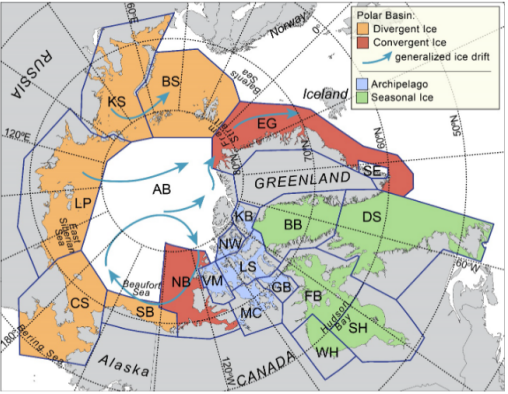
The twenty polar bear management sub-populations are show in the adjacent figure and the table below provides a summary of their status. Counting polar bears is extremely difficult and costly and many areas are deficient in survey data.
The reason polar bears are listed as a vulnerable (IUCN) species is not due to their declining numbers but as a result of numerical climate predictions that show polar bears reduced by two-thirds by 2050 due to ice loss.
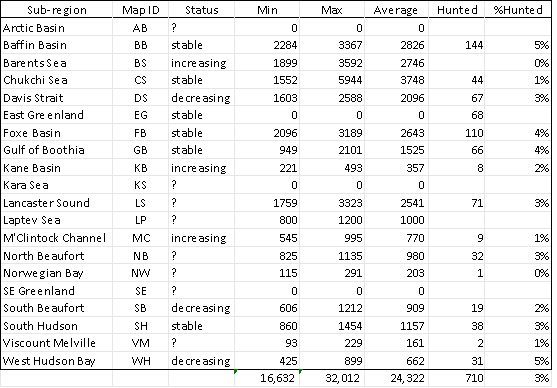
The southern Hudson Bay (SH) sub-population, which is one of the most southerly populations, has been growing over the last few years while the adjacent west Hudson Bay population has been declining. The temperature at Churchill, Manitoba has seen a 2°C increase since 1884.
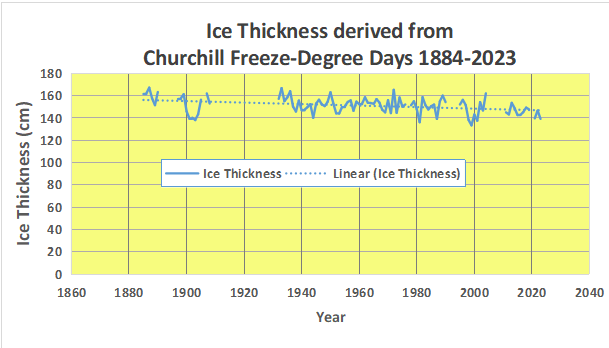
The monthly Churchill temperature record was used to derive freeze degree-days from this the maximum ice thickness record can be calculated. It is seen ice thickness has only decreased from about 160 cm to 150 cm over the last 140 years.